



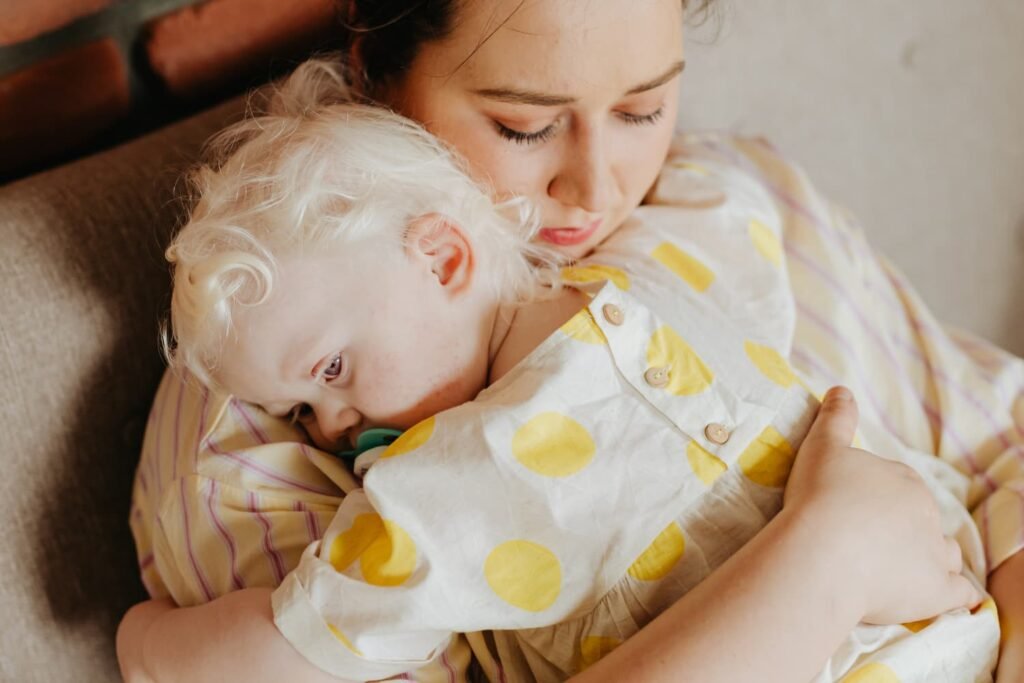
There is grief woven into motherhood — a grief in motherhood that we rarely name.
Not the acute grief we expect—loss, illness, rupture—but a quieter, more disorienting kind. The grief of becoming someone new without ceremony — the identity shift after becoming a mother that no one quite prepares us for. The grief of discovering that love can be vast and still carry ache. The grief of meeting parts of ourselves we did not know were still waiting to be seen.
I have been sitting with this lately, realizing that I have not yet begun to fully process the grief of becoming a mother—or the grief that lives in my relationship to my own mother. Not because the love isn’t real. But because love does not cancel grief. Often, it reveals it.
Motherhood has a way of opening doors we didn’t know were still locked.
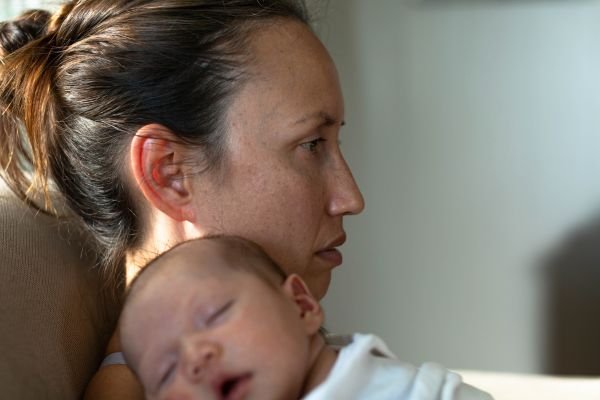
Grief as Initiation in Motherhood
We tend to treat grief as something to “move through,” something to resolve so we can return to normal. But motherhood does not offer a return. It offers a threshold.
This grief in motherhood is not a sign that something has gone wrong. It is a sign that something has mattered deeply enough to change us. It is grief as initiation — a sacred threshold rather than a failure.
There is grief for the self who existed before responsibility became embodied. Grief for the ease we did not know we were carrying. Grief for the imagined versions of motherhood we inherited before we lived it. And sometimes, grief for the mother we needed but did not fully receive—grief that can coexist with gratitude, loyalty, and love.
This grief does not ask to be fixed. It asks to be witnessed.
The Maternal Mirror
Our children do not create this grief, but they often illuminate it. In many ways, they become our quiet teachers — revealing what still aches, what still longs, what still needs tenderness.
In caring for them, we encounter the tenderness we once needed. In responding to their emotions, we feel the echo of our own. In holding their vulnerability, we may feel the weight of what was once held—or not held—for us.
This is not an indictment of our mothers. It is an acknowledgment of lineage — of intergenerational grief and maternal lineage healing unfolding in real time. We are all shaped by what came before us, carrying both nourishment and absence. Motherhood makes that inheritance visible.
Grief arises not because we are doing something wrong, but because we are finally close enough to feel what has always been there.
“The work of grief is not solitary; it is communal.”
Francis Weller, The Wild Edge of Sorrow
Francis Weller writes extensively about grief as sacred, communal ground — an apprenticeship with loss that ripens and deepens us. Learn more about his work in The Wild Edge of Sorrow here.

✨On the days when you forget the sacredness
of what you are holding, let yourself be reminded.
Receive the free poem A Whisper From Me to You as a small offering of encouragement.
Grief without a place to go
If grief is meant to be communal, many of us are grieving without a container — carrying communal grief without the community that once held it.
In Western culture, grief has been steadily privatized. It is something to manage quietly, schedule around, return from quickly. We are taught—often without words—that grief should be discreet, efficient, and ultimately invisible. There are few shared rituals, few sanctioned pauses, and little space to bring grief into ordinary life without explanation.
We do not praise grief.
We do not make time for it.
We rarely know how to sit with it in one another.
Instead, grief is absorbed internally—carried alone in bodies already holding so much. This is especially true in motherhood, where there is often an unspoken expectation of gratitude, resilience, and joy. To grieve while becoming a mother can feel like a contradiction we are not allowed to name.
But grief does not disappear when it is hidden. It simply goes underground.
When grief has no communal witness, it often turns inward—showing up as exhaustion, numbness, irritability, or a sense that something is unfinished but unnamed. Not because we are failing, but because we are grieving without mirrors, language, or shared ground.
To acknowledge this sacred grief is to challenge this inheritance.
It is to remember that grief was once held in circles, rituals, songs, and seasons. That sorrow had shape and sound and companionship. That no one was meant to carry love’s losses alone.
Perhaps part of the work now is not to “process” grief, but to gently re-member what it means to let grief be seen—spoken, honored, and shared in ways that feel possible.
Even quietly.
Even imperfectly.
Even one honest conversation at a time.
Letting grief be sacred
There is a quiet dignity in allowing grief to exist without interpretation.
Not asking it to teach a lesson.
Not turning it into a problem to solve.
Not rushing it toward meaning.
Grief, when given space, becomes a form of reverence. It slows us. Softens us. Deepens our capacity to hold complexity without collapsing into certainty.
Some grief is not meant to be healed. It is meant to be integrated — woven into our becoming through conscious maternal lineage healing. In this way, grief becomes part of the work of re-membering ourselves, gathering what has been scattered and returning to wholeness.
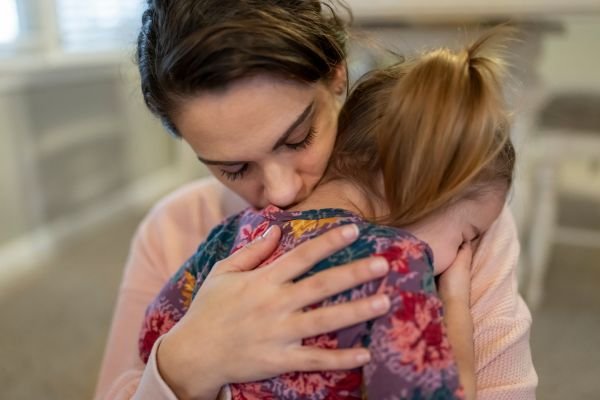
A pause, not a conclusion
This is not a call to process everything at once. It is an invitation to notice what is present—and to remember that noticing does not have to happen alone.
To allow grief to sit beside love without apology.
To honor what has been lost without diminishing what has been given.
To trust that there is wisdom in what aches, especially when it is spoken and received with care.
Some grief softens when it is met by another. Some grief simply needs room to breathe in shared air.
Not all of this work asks for words. Some of it unfolds through presence—through being witnessed, through letting what is heavy be held in relationship, even briefly.
Some work unfolds quietly, over years, without resolution but not without connection.
This is that kind of work.
There is more to say, and not all of it belongs here. Some reflections require a quieter, more intimate space. I’ve shared a deeper continuation of this work on Substack.
If this reflection resonates ✨
The Little Guru Guide: The Mirror and The Message
explores how our children illuminate what still lives within us —
and how to meet that reflection with awareness rather than reaction.
There is a quiet sisterhood in this work.
To the women who mother —
and to the women who mothered us.
To the long line of hearts that have loved imperfectly, fiercely, and without instruction.
We belong to one another in this.
In the love.
In the ache.
In the becoming.
To every mother carrying both tenderness and sorrow in the same body:
I see you.